

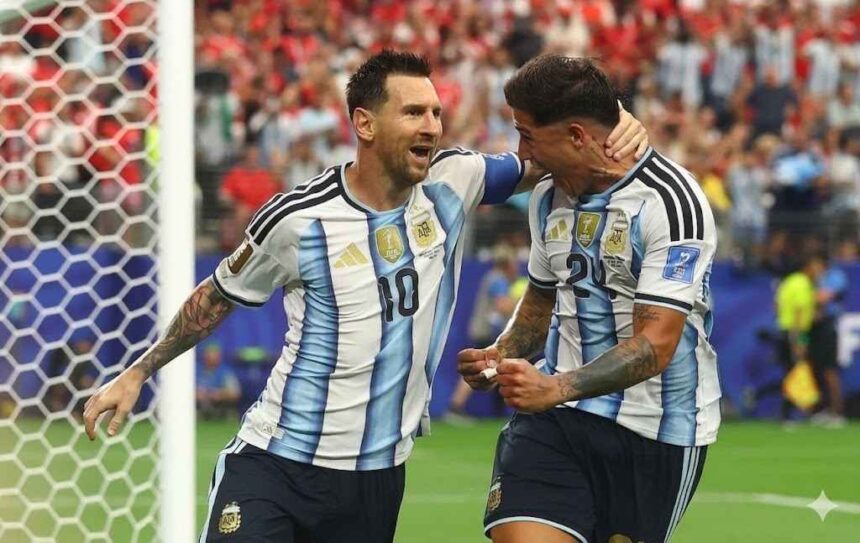
Argentina secured their place in the FIFA World Cup knockout stage with a 2-0 victory over Austria at Dallas Stadium on Monday, but the night belonged to Lionel Messi, who scored twice to become the highest goalscorer in World Cup history.
The Argentine captain delivered another unforgettable performance, netting his record breaking 17th and 18th World Cup goals as the reigning champions maintained their perfect start to the tournament. The victory also extended Argentina’s winning streak to eight matches in all competitions.
Both teams entered the contest with maximum points after opening day victories. Argentina had thrashed Algeria 3-0 thanks to a Messi hat trick, while Austria defeated Jordan 3-1 to stretch their unbeaten run to six matches.
The atmosphere inside the stadium strongly favoured Argentina, with blue and white shirts dominating the stands and creating what felt like a home match for Lionel Scaloni’s side.
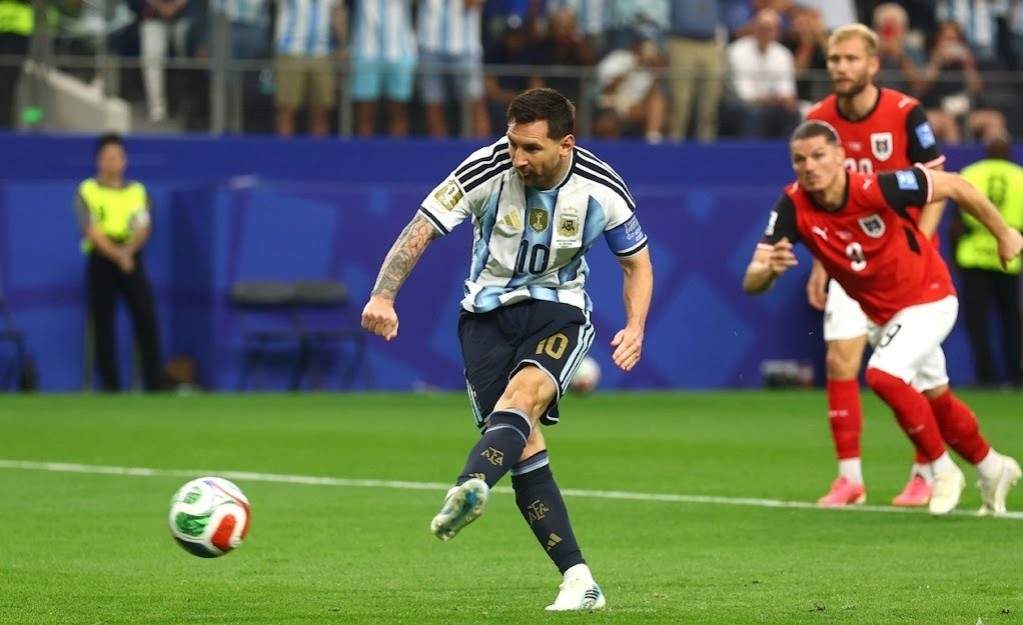
Argentina started brightly and thought they had a golden opportunity to take an early lead in the fifth minute. Lautaro Martinez burst into the penalty area before being brought down by a challenge involving two Austrian defenders. After a VAR review, the referee pointed to the spot.
The decision sparked huge celebrations among the Argentine supporters, but Messi surprisingly failed to convert. The 38 year old dragged his penalty wide of Alexander Schlager’s post, recording the first penalty miss of the tournament. Schlager celebrated wildly as Austria survived the early scare.
Messi remained heavily involved and nearly made amends in the 20th minute when he raced into the box. However, instead of shooting with his right foot, he attempted an extra touch and lost possession.
The breakthrough finally arrived in the 38th minute and it was another historic moment for the Argentine superstar.
Messi began the move himself before continuing his run into the penalty area. After some slick combination play, a low cross found him in space and this time he made no mistake, calmly guiding the ball into the bottom corner.
The goal sent Dallas into celebration and etched Messi’s name even deeper into football history. His 17th World Cup goal moved him clear as the tournament’s all time leading scorer. It also made him only the third player to score in six consecutive World Cup matches, joining France’s Just Fontaine in 1958 and Brazil’s Jairzinho in 1970.
Argentina carried their 1-0 advantage into halftime, with Messi’s landmark strike separating the two sides.
Austria attempted to respond after the break. In the 56th minute, Marcel Sabitzer unleashed a powerful free kick, but Emiliano Martinez remained alert and pushed the effort away.
Argentina continued to control possession and introduced fresh legs midway through the second half, with Julian Alvarez and Nico Gonzalez replacing Lautaro Martinez and Enzo Fernandez.
Austria’s best chance arrived in the 68th minute. Sabitzer delivered an excellent cross into the box, but Facundo Medina did just enough to disrupt Michael Gregoritsch at the far post.
As the clock ticked down, Austria pushed forward in search of an equaliser. Their corner deliveries caused brief concern, but Martinez dealt confidently with everything that came his way.
Then, deep into stoppage time, Messi produced one final piece of magic.
In the 95th minute, he collected possession on the right flank and drifted inside before releasing Julian Alvarez. Although Alvarez failed to finish the move cleanly, Messi refused to give up. He followed the play, reacted quickest to the loose ball and slotted home his second goal of the night.
Goal number 18 sealed the victory and further strengthened his place in World Cup history.
Moments later, Messi nearly completed a stunning hat trick when he curled a long range free kick narrowly wide of the post. The crowd held its breath as the ball flashed past the target.
When the final whistle sounded, Argentina celebrated qualification for the Round of 32, while Messi once again dominated the headlines.
The football icon now has five goals in just two matches at this World Cup after following his opening game hat trick against Algeria with another decisive brace against Austria.
Before the match, Argentina and Austria had never met at the World Cup. Argentina had remained unbeaten in their previous two meetings, including a 5-1 friendly victory in 1980 that featured Diego Maradona’s only international hat trick and a 1-1 draw in Vienna in 1990.
Now, another Argentine legend continues to rewrite the record books. With his 39th birthday only two days away, Messi delivered yet another masterclass and showed that age remains no barrier to greatness on football’s biggest stage.