
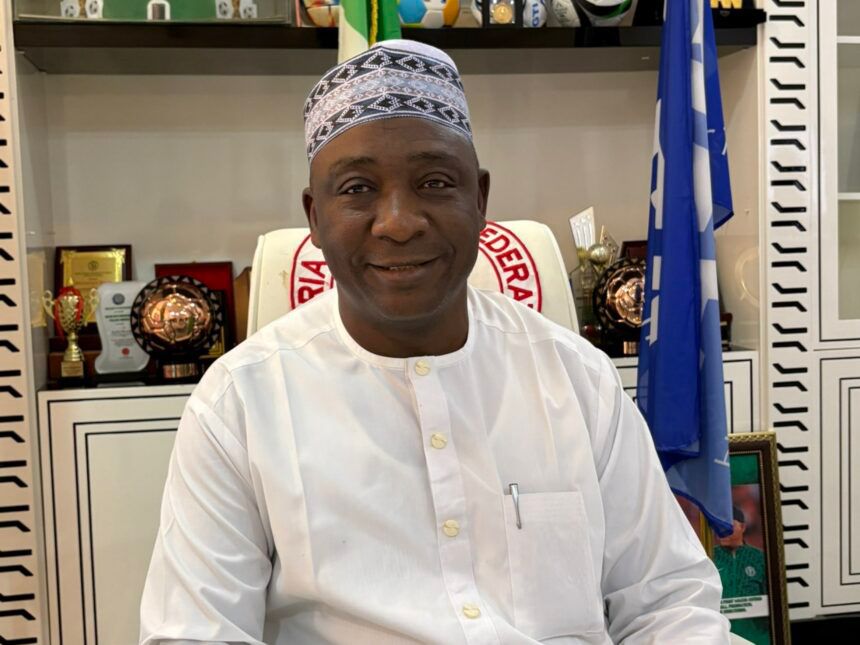
Ibrahim Musa Gusau has officially resigned as President of the Nigeria Football Federation (NFF), confirming reports that emerged earlier Thursday and bringing his four-year tenure at the helm of Nigerian football to an abrupt end, Trybal News reports.
Gusau confirmed his decision during a press conference at the NFF headquarters in Abuja, where he addressed the uncertainty surrounding his position and the wider crisis within the federation.
After consultation with family, friends, stakeholders and all, I just want to tell you that I decided to resign my position as President,” Gusau told journalists.
He said the decision followed extensive consultations as pressure continued to mount around the NFF leadership.
Because of that, there was so much clamour from here and there, from all stakeholders, everybody,” he said.
And we knew it was important to see that at least nobody is better than us. And we all love our country, and we all love the progress of our country.”
Gusau also confirmed that he had informed members of his board of his decision and advised them to resign.
I then advised my board members, I informed them, and I advised them,” he said.
The NFF General Secretary, Dr Mohammed Sanusi, has also stepped down from his position, while several members of the federation’s Executive Committee are reported to have resigned.
Gusau, however, indicated that communication within the federation had broken down, revealing the extent of the internal crisis.
I’m not communicating with the board, they are not communicating to me. I’m not communicating with the other assembly,” he said.
The official confirmation comes after reports of Gusau’s resignation first surfaced earlier Thursday, creating uncertainty over whether the NFF president had formally left office. His appearance before the media and subsequent announcement have now provided clarity on the matter.
Gusau’s resignation follows a prolonged period of pressure over the performance and administration of Nigerian football.
The Super Eagles failed to qualify for the 2026 FIFA World Cup, missing the tournament for a second consecutive edition. The situation became even more difficult for the NFF following the Super Falcons’ historic failure to qualify for the 2027 FIFA Women’s World Cup.
Nigeria had featured at every edition of the Women’s World Cup since the tournament began in 1991.
The Falcons entered the 2026 Women’s Africa Cup of Nations as defending champions but suffered a 1-0 quarter-final defeat to Cameroon. Nigeria subsequently lost 2-1 to South Africa in the World Cup qualification play-off, ending the country’s hopes of appearing at the 2027 tournament.
The setbacks generated widespread criticism of the NFF administration and prompted the federation to establish a fact-finding committee to investigate the causes of the national teams’ recent failures.
Pressure beyond the pitch
The leadership crisis has also unfolded against a backdrop of increasing scrutiny of the federation’s finances and administration.
Reports of investigations involving the Economic and Financial Crimes Commission (EFCC), Independent Corrupt Practices and Other Related Offences Commission (ICPC) and the State Security Service (SSS) over the utilisation of federal government intervention funds have added another layer to the pressure surrounding the NFF.
The reported investigations concern the handling of funds released to the federation for outstanding obligations, including payments relating to the national teams.
The financial scrutiny, combined with the national teams’ poor results and growing questions about the federation’s leadership, intensified calls for change.
Election now in focus
Gusau’s resignation comes just one month before the NFF’s scheduled Elective Congress in Lafia, Nasarawa State, on September 27.
The congress was expected to determine the federation’s leadership for the next four-year cycle, with Gusau previously positioned to seek another term.
His resignation, together with the reported departure of other members of the Executive Committee, has now created fresh uncertainty over the electoral process and the immediate administration of Nigerian football.
Gusau was elected NFF president in September 2022, succeeding Amaju Pinnick. His administration recorded notable successes, including the Super Falcons’ 2025 WAFCON triumph, which extended Nigeria’s record to 10 continental titles.
However, the final phase of his tenure became increasingly dominated by the failure of both senior national teams to qualify for their respective World Cups and growing demands for accountability and reform.
With Gusau now officially gone, and other senior officials also stepping aside, Nigerian football faces a significant leadership transition.
The immediate questions are who will oversee the federation, how the September 27 election will be affected and whether the current crisis will lead to a broader restructuring of the administration of Nigerian football.
For now, what began as reports of Gusau’s resignation has been formally confirmed by the man himself.
The Gusau era at the NFF is over.