
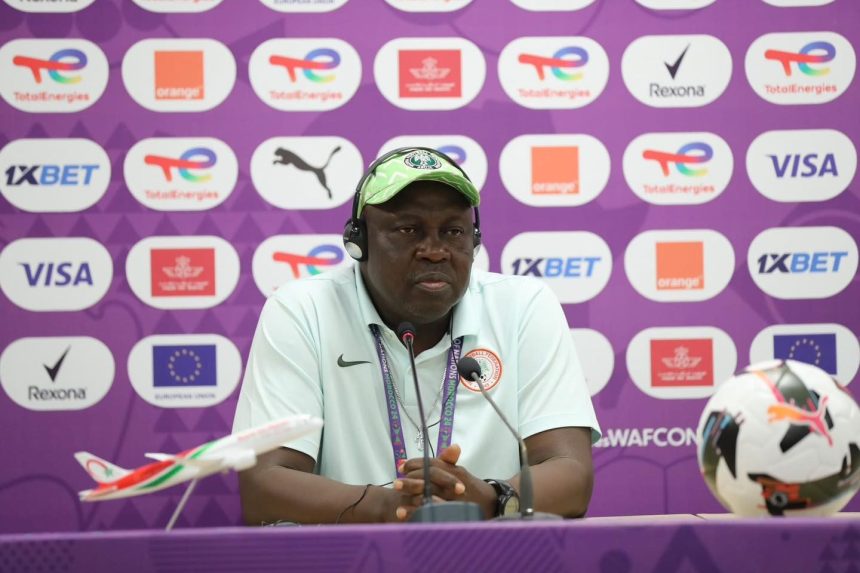
Nigeria’s Super Falcons head coach Justin Madugu has revealed the growing difficulties being faced by the national team in securing international friendly matches, admitting that several countries have deliberately refused to play against the African champions.
Concerns over the shortage of games have continued to rise around the Super Falcons camp as preparations intensify for future international tournaments. The situation has now been openly addressed by Madugu, who disclosed that repeated efforts made by the Nigeria Football Federation to arrange fixtures have largely been unsuccessful.
Speaking in an exclusive interview with Brila.net, the coach explained that many football associations initially show interest before eventually pulling out once discussions reach their technical departments.
“The fact is that most of the teams are not ready to play us. I am aware they have made a lot of efforts at trying to reach out to so many teams,” Madugu said.
According to the Falcons boss, several countries have already been approached, but invitations have consistently been rejected.
“The federation will accept by the time they approach their coaches, they will say no, they don’t want to play the Super Falcons.”
The frustration surrounding the issue was further emphasised as Madugu disclosed that more than five countries had already been contacted without success.
“I’m aware they have made approaches to more than five countries.”
“That I know.”
“Maybe some other reasons could be behind it, but we’re not happy about it.”
The lack of quality international fixtures has been described as a major setback for the team’s preparation plans. Important aspects such as tactical development, team chemistry and player assessment have all been affected by the shortage of games.
“We’re not happy about it because it’s not helping our preparations also,” he admitted.
With very few elite opponents willing to face Nigeria, Madugu acknowledged that the coaching crew has been left in a difficult position.
“But then, what can you do when you don’t have anybody that is ready to play against you?”
The Super Falcons remain Africa’s most successful women’s national team and are still widely regarded as one of the most feared sides on the continent. Madugu suggested that Nigeria’s reputation may now be discouraging other countries from agreeing to fixtures.
European teams in particular were identified as focusing mainly on opponents within their own continent because of ongoing FIFA Women’s World Cup qualifying campaigns.
“Some other countries, particularly the European teams, they are more focused on playing against European teams because of their World Cup qualifiers,” Madugu explained.
He also revealed that some European nations are intentionally avoiding African opposition altogether during this period.
“However, some of the approaches that have been made, even with the European teams, some of them are not willing to play African teams for now, but they rather prefer to play against the European opposition, particularly the top countries.”
Despite the growing frustration, Madugu maintained that the team would continue working hard while hoping the situation improves.
“It’s affecting our preparations. We are not happy about it.” You need games to improve, We will keep working”
The coach further noted that qualification situations often influence how countries choose their opponents.
“If they had qualified for the World Cup, probably knowing fully well that they will come up against teams from different continents, they might be of light in wanting to play us.”
Madugu’s comments come months after he guided Nigeria to a historic 10th Women’s Africa Cup of Nations title in Morocco. The Super Falcons produced a memorable comeback performance to defeat hosts Morocco 3-2 in the final, a triumph that further strengthened his growing reputation as one of Africa’s leading indigenous coaches.
Reflecting on that achievement earlier in an interview with CAFOnline, Madugu stressed the importance of changing perceptions around Nigerian coaches and proving they can succeed at the highest level.
“We needed to set a good benchmark for our home-based coaches who’ve previously lost hope. When we were given this task, we knew it was huge, we weren’t just representing ourselves. I believe strongly that this achievement will open up more doors for Nigerian coaches at every level.”
“It’s about changing the perception, proving that we can compete and win at the very top. We’ve not disappointed, and that is the joy that fills me the most,” he added.