
The Economic and Financial Crimes Commission (EFCC) and the Independent Corrupt Practices and Other Related Offences Commission (ICPC) are investigating the utilisation of the N12 billion Federal Government intervention fund released to the Nigeria Football Federation (NFF) to settle outstanding players’ wages, bonuses and other national-team obligations, Trybal News reports.
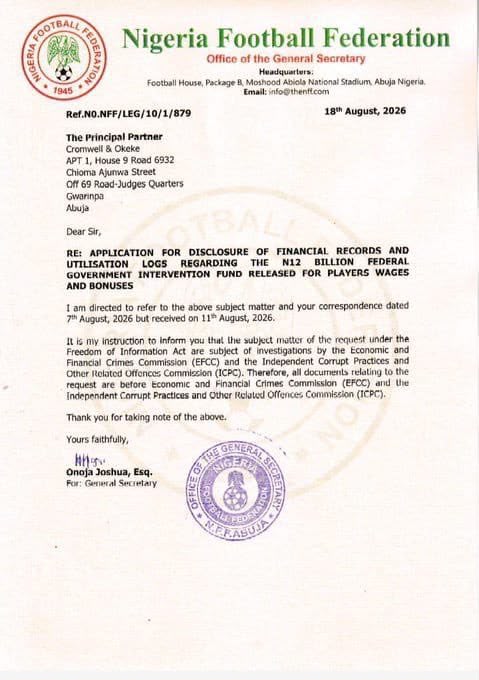
The development was disclosed by the NFF in a letter dated August 18, 2026, responding to a Freedom of Information request seeking financial records and utilisation logs relating to the intervention fund.
In the letter, referenced NFF/LEG/10/1/879 and signed by Onoja Joshua on behalf of the NFF General Secretary, the federation said it could not release the requested documents because the matter was already the subject of investigations by the two anti-corruption agencies.
It is my instruction to inform you that the subject matter of the request under the Freedom of Information Act is the subject of investigations by the Economic and Financial Crimes Commission (EFCC) and the Independent Corrupt Practices and Other Related Offences Commission (ICPC),” the letter stated.
The NFF added that “all documents relating to the request are before” the EFCC and ICPC.
The federation, however, did not disclose the specific transactions or activities under investigation, when the probes commenced, or whether any of its officials had been questioned by the agencies.
The N12 billion intervention fund was approved by President Bola Tinubu in January 2024 to clear outstanding financial obligations owed to Nigeria’s national teams and coaches.
According to the Presidency at the time, the intervention covered up to 15 months of outstanding salaries owed to Super Eagles coaches, as well as allowances and other payments due to the senior men’s and women’s national teams and the Under-20 side.
The revelation of the investigations comes amid mounting scrutiny of the administration and financing of Nigerian football, following a series of disappointing results by the country’s national teams and growing calls for reforms within the NFF.
The Super Eagles failed to qualify for the 2026 FIFA World Cup, while the Super Falcons also failed to secure qualification for the 2027 FIFA Women’s World Cup.
The financial concerns have also continued despite the Federal Government’s intervention. Questions have previously been raised over outstanding allowances and bonuses owed to members of Nigeria’s national teams.
Meanwhile, the Senate Committee on Sports has summoned officials of the NFF and the National Sports Commission for an emergency meeting over what it described as concerns surrounding the decline of Nigerian football.
The committee chairman, Senator Abdul Ningi, said the Senate was particularly concerned about the Super Eagles’ failure to qualify for the 2026 World Cup and the Super Falcons’ failure to qualify for the 2027 Women’s World Cup.
The latest development places renewed focus on the management and utilisation of public funds allocated to Nigerian football, with the EFCC and ICPC investigations now expected to determine whether any financial irregularities occurred in the handling of the N12 billion intervention.