Nigeria wasted no time reminding the rest of the Commonwealth Games participating nations that they remain one of the biggest forces in para-sport. While swimmers chased medals in the pool and household names delivered memorable performances, it was Nigeria’s para-powerlifting team that stole the spotlight with a breathtaking display of strength, dominance and world-class excellence.
The opening day featured 14 medal events across swimming and para-powerlifting, producing world records, Commonwealth Games records and emotional victories. Yet no nation imposed itself quite like Nigeria, whose athletes claimed three of the four available para-powerlifting gold medals while rewriting the record books.
From Folashade Oluwafemiayo’s incredible world-record lifts to Riluwan Idris’ commanding performance, Nigeria announced itself as one of the biggest success stories of the Games before many competitions had even settled into rhythm.
Folashade Oluwafemiayo Once Again Proves She Is Untouchable
Whenever Folashade Oluwafemiayo steps onto the platform, expectations naturally rise. Once again, she delivered.
The double Paralympic champion produced another astonishing performance in the women’s heavyweight competition, successfully lifting 165kg, 172kg and an incredible 175kg.
Her efforts earned her the gold medal and a new +86kg world record with 134.8 points, further cementing her status as one of the greatest para-powerlifters the sport has ever produced.
The event also delivered another remarkable Nigerian achievement.
World champion Rita Ferdinand finished second after setting a +79kg world record with 128.2 points, giving Nigeria a dominant one-two finish.
Australia’s Hani Watson completed the podium, but her bronze carried historic significance as she secured Australia’s first-ever Commonwealth Games medal in para-powerlifting.
Nigeria Complete Another Stunning One Two Finish
Nigeria’s dominance continued in the women’s lightweight division.
Paris 2024 silver medallist Esther Nworgu lived up to expectations by winning gold with a new Commonwealth Games record of 119.0 points.
Behind her came another Nigerian success story.
Veteran lifter Esther Oyema secured silver to complete yet another Nigerian one-two finish, while England’s Olivia Broome collected bronze after an impressive performance.
By the end of the session, Nigeria had already established complete authority over the competition.
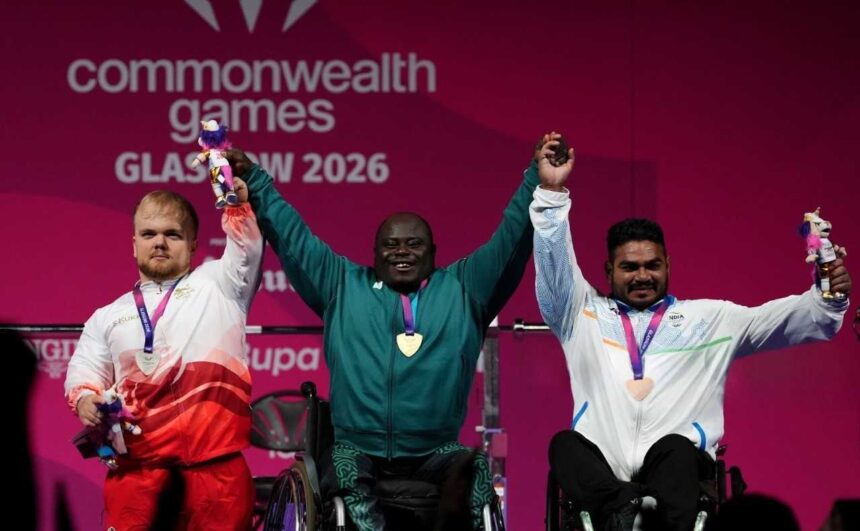
The Nigerian celebrations continued in the men’s heavyweight category.
Riluwan Idris produced one of the finest performances of the day, lifting an impressive 208kg despite weighing just 86 kilograms.
His total of 132.8 points secured another gold medal for Nigeria after a composed and technically excellent performance.
England’s Matthew Harding pushed him throughout the contest but eventually settled for silver after finishing just 1.8 points behind.
India’s Jhandu Kumar completed the podium with bronze.
One Event Stops a Nigerian Clean Sweep
Only one competition prevented Nigeria from completing a perfect sweep of all four para-powerlifting titles.
Paris 2024 silver medallist Mark Swan claimed gold in the men’s lightweight category after lifting 222kg.
His final score of 153.9 points matched Nigeria’s Roland Ezuruike exactly. However, Swan secured victory after edging the Nigerian on the official tie-break by the smallest possible margin.
Paris 2024 Paralympic champion Bonnie Bunyau Gustin finished third after lifting 220kg to earn 153.5 points.
Although Nigeria narrowly missed a fourth gold medal, their overall dominance remained beyond question.
Australia Rule the Swimming Pool
While Nigeria dominated the lifting platform, Australia controlled proceedings inside the swimming arena.
The Australians collected six gold medals across nine swimming and para-swimming finals, underlining their remarkable depth.
Lani Pallister opened the golden run by winning the women’s 400 metres freestyle in three minutes 59.56 seconds. She finished ahead of New Zealand’s Erika Fairweather, the reigning world champion, while fellow Australian Jenna Forrester secured bronze.
Australia then showcased its relay strength once again.
The women’s 4×100 metres freestyle relay team of Meg Harris, Shayna Jack, Mollie O’Callaghan and Alex Perkins stormed to victory in 3:31.40 ahead of England and South Africa.
The men’s quartet followed with another outstanding display.
Led by Olympic champion Kyle Chalmers, Australia claimed gold in a new Commonwealth Games record time of 3:09.49, finishing ahead of England and South Africa.
Chad le Clos Makes Commonwealth Games History
Although South Africa settled for bronze in the men’s relay, the evening still belonged to Chad le Clos.
The legendary swimmer collected his 19th Commonwealth Games medal, becoming the most decorated athlete in the history of the competition.
An emotional le Clos admitted the achievement meant far more than another medal.
“I’ll try not to cry here, but it’s a big moment for me. I’m grateful for the boys. It’s been a tough two years, tough four years, after those near misses in Birmingham. I’d be lying if I said it wasn’t a big moment for me and my family, so I’m really grateful,” he said.
It was another reminder of the incredible legacy the South African icon continues to build.
Jenna Forrester completed an outstanding day by winning her second medal after taking gold in the women’s 200 metres backstroke ahead of Scotland’s Katie Shanahan and Australia’s Hannah Fredericks.
“Those results were absolutely awesome. I’ve got my whole support crew back home to thank for that. They definitely put in the work as well as me to get me here, so I can’t thank them enough,” Forrester said.
Australia also celebrated victories from Paralympic bronze medallist Alex Saffy in the men’s 100 metres S10 butterfly and Jenna Jones in the women’s 100 metres S13 freestyle.
Scotland enjoyed its own memorable evening.
Double Olympic relay champion Duncan Scott captured gold in the men’s 200 metres individual medley with a new Commonwealth Games record of 1:56.38. The victory earned Scott his fourth Commonwealth gold medal and his 14th overall medal.
Faye Rogers added another Scottish triumph by winning the women’s 200 metres SM10 individual medley ahead of Australia’s Jasmine Greenwood and Canada’s Mary Jibb.
Away from the medals, the opening day also marked the start of the men’s and women’s 3×3 basketball and wheelchair basketball tournaments.
Australia made another impressive statement by winning all three of their pool matches in both the men’s and women’s competitions, carrying their excellent opening-day momentum into the team events
Nigeria Leave Day One as the Nation Everyone Must Catch
Several athletes produced unforgettable moments across an action-packed opening day.
Australia dominated the swimming pool. Chad le Clos added another remarkable chapter to his legendary career. Duncan Scott continued building his Commonwealth legacy.
Yet the biggest statement belonged to Nigeria.
Three gold medals, multiple world records and repeated podium sweeps sent a powerful message to every competing nation. If the opening day is any indication, Nigeria’s para-powerlifting team could once again become one of the defining stories of these Commonwealth Games.