

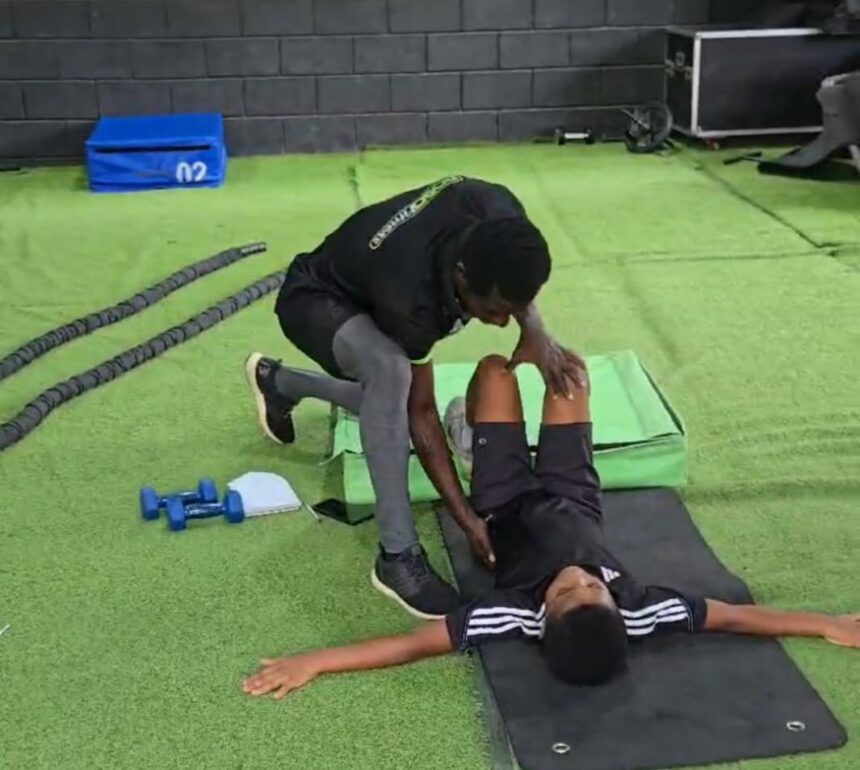
Nigerian Strength and Conditioning Coach and Football Performance Specialist Olayinka Balogun, widely known as Toptrainer, has unveiled a new practical framework aimed at improving the physical development of modern footballers. The framework is contained in his latest professional publication, Speed, Strength & Agility: A Practical Framework for Developing the Modern Footballer, his second practitioner publication, Trybal News reports.
Balogun’s work focuses on the growing physical demands of the modern game, arguing that speed, strength and agility cannot be treated as separate elements of football development. According to the coach, players must be capable of producing and absorbing force, accelerating quickly, braking under control, changing direction and repeatedly performing explosive actions while still maintaining the technical and tactical demands of the game.

At the centre of his approach is the TOPTRAINER Football Performance Pathway, built around five stages: MOVE, BUILD, EXPLODE, ACCELERATE and PERFORM. The progression begins with movement quality and coordination before advancing through strength and force development, explosive power, speed and change of direction, ultimately transferring those qualities into football performance. Balogun stresses that players should progress according to their individual needs and readiness rather than simply copying training programmes designed for elite athletes.
The publication also challenges the traditional perception of agility training, with Balogun pointing out that quickly completing an agility ladder does not necessarily make a player more agile on the pitch. He advocates training that develops acceleration, braking, body control and the ability to react to opponents, teammates and the ball. He also calls for closer integration between gym and pitch work, warning that poorly managed physical workloads can leave players fatigued when they need to perform at their highest level.
For Balogun, the ultimate objective is simple: physical preparation must serve football performance. His philosophy places quality over exhaustion, individualisation over imitation and consistency over novelty, with the belief that well-structured physical development can help players maximise their technical and tactical abilities. The publication provides coaches, academies and developing players with a practical roadmap for building the physical qualities increasingly demanded by the modern game.