

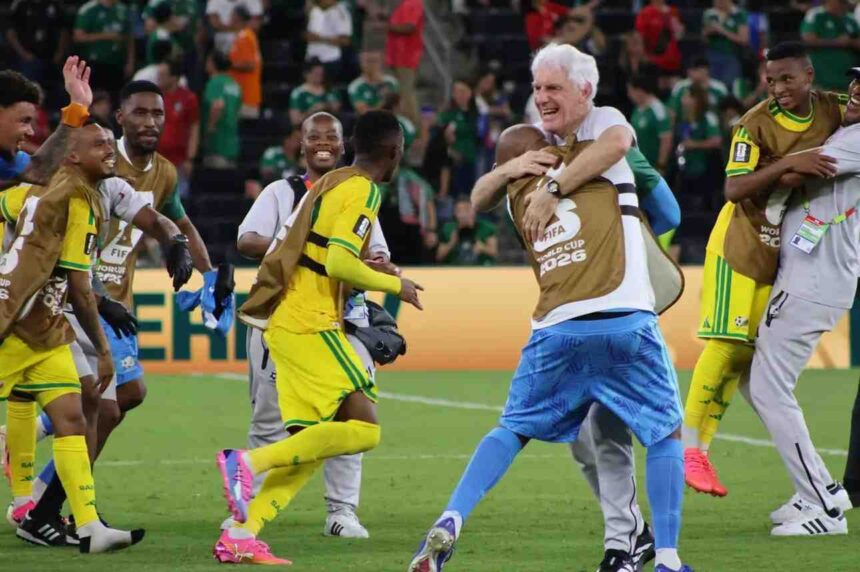
Bafana Bafana have done what generations of South African footballers could not. Hugo Broos’ side secured a historic place in the knockout rounds of the 2026 FIFA World Cup after grinding out a disciplined 1-0 victory over South Korea in Monterrey.
For a nation that has often arrived at major tournaments carrying hope but departed with disappointment, this result felt different. It was not built on flair or domination. Instead, Bafana Bafana relied on organisation, resilience and clinical execution to write a new chapter in South African football history.
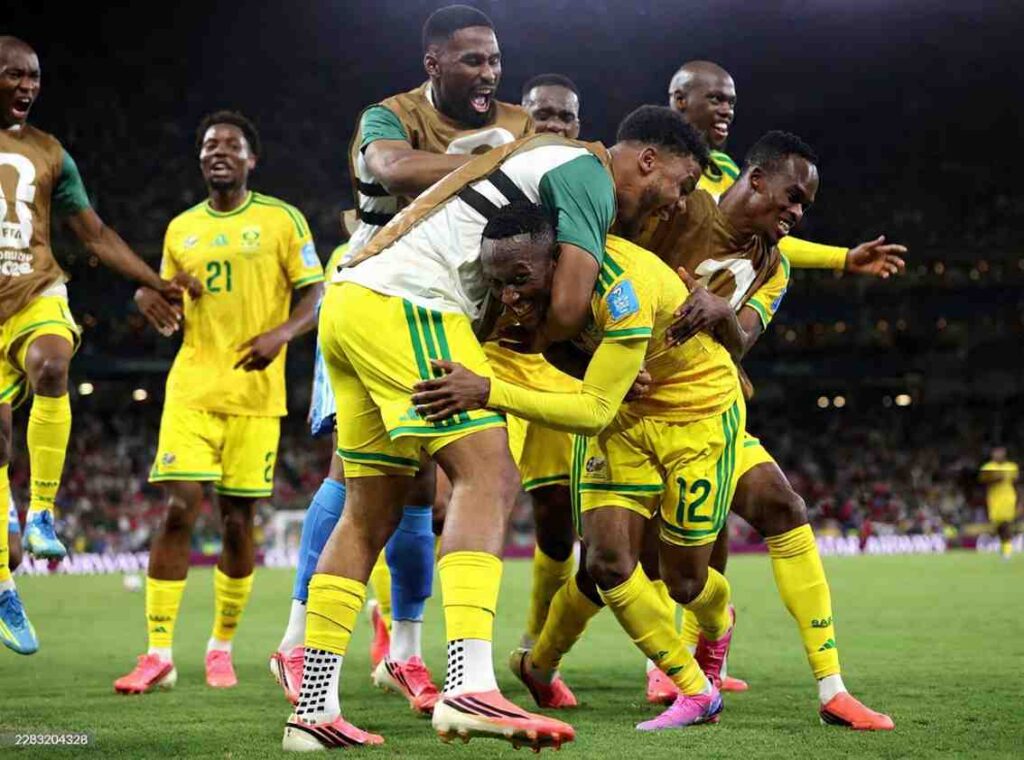
Thapelo Maseko’s second-half winner settled a tense contest in front of 51,243 supporters at Estadio BBVA and ensured South Africa reached the knockout stage of a World Cup for the first time ever.
Bafana Bafana Show the Value of Discipline
The statistics tell an unusual story.
Bafana Bafana controlled only 32 percent of possession and spent long periods defending against a South Korean side determined to dictate the tempo. Yet possession rarely translated into genuine danger for the Asians.
South Africa actually outshot their opponents 13 to 8 and edged the expected goals battle 1.10 to 1.00.
That balance perfectly reflected the match itself.
While South Korea monopolised the ball, Bafana Bafana looked more dangerous whenever opportunities appeared. Hugo Broos instructed his players to stay compact, close passing lanes and attack quickly when possession changed hands.
The plan worked almost perfectly.
South Africa lined up in a disciplined 4-2-3-1 system, while South Korea operated in a 3-4-2-1 formation designed to stretch the pitch. However, Bafana Bafana repeatedly denied their opponents the spaces they wanted to exploit.
Even before the winning goal arrived, South Africa looked the more threatening side.
A Strong First Half Set the Platform
The final possession figures do not tell the full story.
During the first half, Bafana Bafana enjoyed 39 percent of the ball and produced the better attacking moments. They registered 10 shots compared to South Korea’s four and created the only major chance before the break.
The expected goals numbers reinforced South Africa’s superiority.
At halftime, Bafana Bafana held a 0.92 to 0.43 advantage in expected goals despite South Korea completing more passes.
Their willingness to run beyond the Korean defence also stood out. South Africa were caught offside three times before the interval, evidence of a team looking to attack space rather than simply survive.
Meanwhile, South Korea moved the ball neatly but struggled to penetrate dangerous areas.
The platform had been established. Bafana Bafana simply needed one decisive moment.
Maseko Delivers the Moment That Changed Everything
South Korea responded at halftime by introducing Son Heung-min, Jin-gyu Kim and Jens Castrop.
The changes increased their control.
They dominated possession after the break, recording 76 percent of the ball and forcing South Africa deeper into their own half. Corners, final-third entries and territorial pressure all swung heavily in South Korea’s favour.
However, football often rewards efficiency over control.
In the 62nd minute, Hugo Broos introduced Tshepang Moremi in place of Oswin Appollis.
Just one minute later, the substitute played a key role in the winning goal.
The move began deep inside South Africa’s own half. Ime Okon started the sequence before Evidence Makgopa linked play cleverly. Relebohile Mofokeng then found Moremi on the right flank.
Moremi delivered the decisive pass.
Maseko stepped inside, created space and fired a superb left-footed finish beyond Kim Seung-gyu in the 63rd minute.
One move. One finish. One moment of history.
The goal only increased South Korea’s urgency.
Bafana Bafana knew they would have to suffer during the closing stages.
Yet their defensive display was exceptional.
South Africa recorded 42 clearances compared to South Korea’s 15. They also produced 15 interceptions while consistently disrupting passing lanes and cutting out dangerous deliveries.
Although South Korea registered 81 final-third entries and attempted 33 crosses, only seven found a teammate.
That statistic highlights the quality of South Africa’s defensive organisation.
Ronwen Williams remained calm throughout, while the defenders repeatedly threw themselves in front of shots and crosses.
The final six minutes of stoppage time felt endless, but Bafana Bafana never panicked.
They protected their penalty area with remarkable discipline and fully deserved the final whistle.
Hugo Broos Has Achieved What Legends Could Not
This achievement carries enormous significance.
Before this tournament, South Africa had won only two of their previous 11 World Cup matches. One of those victories came against a chaotic France side during the 2010 tournament on home soil.
Few expected Bafana Bafana to survive this group.
Many believed South Africa lacked the pedigree required to compete against more established football nations. Yet Broos and his players ignored those doubts.
They have now succeeded where teams featuring Lucas Radebe, Steven Pienaar, Benni McCarthy and Quinton Fortune fell short.
That reality alone underlines the magnitude of this accomplishment.
Broos deserves immense credit. He built a team greater than the sum of its individual parts and created a group that understands exactly how it wants to play.
A Difficult Night for Son and South Korea
While South Africa celebrated, South Korea faced an anxious wait.
Much of the attention focused on Son Heung-min.
Widely regarded as the greatest South Korean and Asian footballer of all time, the Tottenham star began the match on the bench as he approaches his 34th birthday.
His introduction at halftime improved South Korea’s attacking rhythm but could not prevent defeat.
A draw would have guaranteed qualification and removed any uncertainty. Instead, South Korea must now rely on the third-place rankings and other results.
Questions will inevitably emerge about whether this was Son’s final World Cup appearance.
If it was, it ended in disappointment.
If not, he may yet get one final opportunity to add another chapter to an extraordinary international career.
What Comes Next for Bafana Bafana?
History has already been made.
However, Bafana Bafana may not be finished yet.
Canada now await in Los Angeles on June 28 and confidence will be growing throughout the South African camp. This team continues to improve with every game and now carries the belief that it belongs on this stage.
Momentum can be powerful at a World Cup.
Bafana Bafana have it.