
With just 50 days remaining until the 2026 FIFA World Cup begins, anticipation is reaching a peak across the footballing world. Years of planning and expectation are about to culminate in what will be the largest edition of the tournament ever staged.
From June 11 to July 19, 2026, North America will host a competition spanning 48 teams and 104 matches, a масштаб expansion designed by FIFA to reflect the sport’s global reach.
For Africa, the stakes go beyond participation. The continent arrives not only with increased representation but with renewed belief. The question now is whether that belief can translate into another historic run to the semi-finals or beyond.
A Tournament of Firsts and Shifting Power
The 2026 edition is not merely bigger, it represents a structural shift in international football. With 48 nations competing, countries previously absent from the global stage, such as Cape Verde and Jordan, will now take their place among football’s elite.
The expanded format also coincides with a generational transition. Established stars like Kylian Mbappe continue to build on already remarkable World Cup legacies, while players such as Erling Haaland prepare for their first appearance on football’s biggest stage. Meanwhile, emerging talents including Lamine Yamal, Estêvão, Nico Paz, Lennart Karl and Nico O’Reilly are expected to use the tournament as a platform to announce themselves globally.
This convergence of experience and youth gives the 2026 World Cup a unique character, one where the balance of power could shift dramatically.
Africa’s Historic Opportunity
For the first time, ten African nations will compete at the World Cup, a significant increase from the traditional five slots. Morocco, Tunisia, Egypt, Algeria, Senegal, Ivory Coast, Ghana, Cape Verde, South Africa and the Democratic Republic of the Congo have all secured qualification.
This expansion offers more than representation; it provides depth and diversity in Africa’s challenge. The continent’s ambitions are no longer limited to participation or isolated success stories.
The benchmark, however, remains Morocco’s historic run in 2022, when they became the first African nation to reach the semi-finals. That achievement not only inspired, it altered expectations.
Morocco: From Breakthrough to Benchmark
Morocco enter the 2026 tournament with a different status. No longer underdogs, they are now seen as a team capable of repeating, or even surpassing, their 2022 success.
Their campaign in Qatar saw them top a group featuring Croatia and Belgium, eliminate Spain on penalties and defeat Portugal in the quarter-finals before eventually losing to France. It was a run defined by tactical organisation, defensive discipline and collective belief.
Now led by Mohamed Ouahbi, who previously guided Morocco’s youth teams to international success, the focus is on continuity. With a strong development structure and recent domestic and regional achievements, Morocco’s progress appears sustained rather than sporadic.
The challenge in 2026 is clear: prove that their previous success under Walid Regragui was not an anomaly, but the foundation of a new era.
Senegal: Experience Meets Expectation
Senegal approach the tournament as one of Africa’s most stable and balanced teams. Under coach Pape Thiaw, the squad blends seasoned leaders with a new generation of talent.
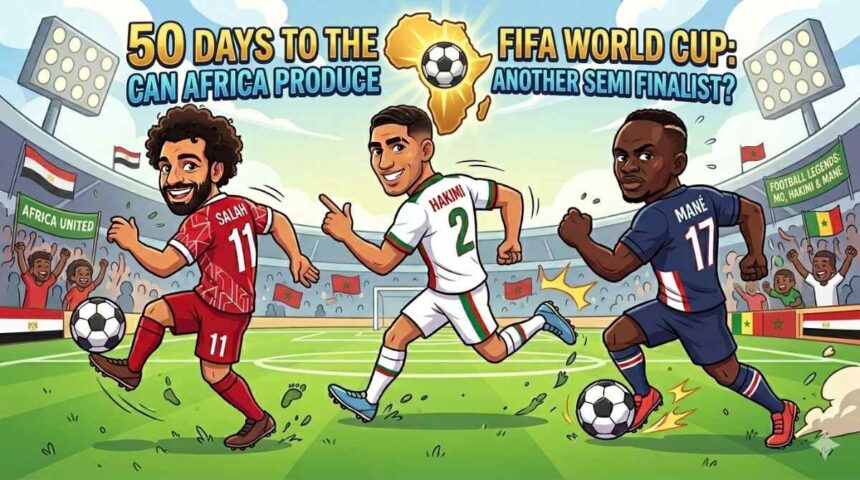
Sadio Mane remains central to their attacking threat, while Kalidou Koulibaly provides defensive leadership. In goal, Edouard Mendy offers reliability, and the midfield pairing of Idrissa Gueye and Pape Matar Sarr ensures tactical balance.
Senegal’s World Cup history includes a memorable quarter-final run in 2002, where they defeated reigning champions France. Their recent Africa Cup of Nations triumph further underlines their pedigree.
However, off-field disputes surrounding 2025 AFCON stripped title has added an element of uncertainty. How the team manages that distraction could prove crucial.
Egypt: A Legacy at Stake
For Egypt, the narrative is deeply tied to Mohamed Salah.
Widely regarded as the greatest player in the nation’s history, Salah has achieved extraordinary success at club level. Yet on the international stage, major honours have remained elusive, and Egypt’s World Cup record is modest.
Across three appearances, the team has never recorded a single victory. Their most recent outing in 2018 ended in three consecutive defeats, despite Salah scoring twice under difficult circumstances following injury.
Preparations for 2026 have been extensive, including high-profile friendlies scheduled against Brazil and European opposition. For Egypt, even a deep run without winning the tournament could redefine their global standing and reshape Salah’s legacy.
Ghana and Algeria: Rebuilding with Purpose
Ghana enter the tournament under new leadership, with Carlos Queiroz tasked with restoring stability and direction after Otto Addo was sacked 10 weeks to the 2026 FIFA World Cup. Their historic quarter-final run in 2010 remains a reference point, but recent years have been marked by inconsistency.
A series of preparatory matches, including a friendly against Mexico, will be key in shaping their final squad.
Algeria, meanwhile, return to the World Cup after missing the previous two editions. Led by Riyad Mahrez, they combine experienced players with emerging talent. Their memorable performance in 2014, where they reached the Round of 16 and pushed eventual champions Germany to extra time, serves as motivation.
Emerging Narratives Across the Continent
Beyond the traditional powerhouses, several African teams are building compelling narratives.
South Africa, returning for a fourth World Cup, will open their campaign against Mexico in a symbolic repeat of the 2010 tournament opener. Ivory Coast have shown strong form in recent friendlies, while Tunisia’s disciplined qualification campaign suggests they could challenge for a first knockout stage appearance.
The Democratic Republic of the Congo’s return after more than 50 years adds historical significance, while Cape Verde’s debut represents the expanding reach of African football.
The Challenge Ahead
Despite individual successes, African teams have historically struggled to maintain consistency at the World Cup. Breakthrough performances have often been followed by early exits in subsequent tournaments.
However, the landscape at the 2026 FIFA World Cup is different. Greater representation, improved player development and increased exposure to top-level football have strengthened the continent’s overall competitiveness.
The expanded format may also provide more pathways for African teams to progress deeper into the tournament.
As the countdown continues, Africa stands at a pivotal moment. With ten teams participating and a generation of players competing at the highest levels globally, expectations have never been higher.
The question remains whether the continent can build on Morocco’s historic achievement and go even further.
What is certain is that Africa will not arrive as mere participants. This time, they come with hope and belief, ready to test the limits of possibility on football’s biggest stage.