
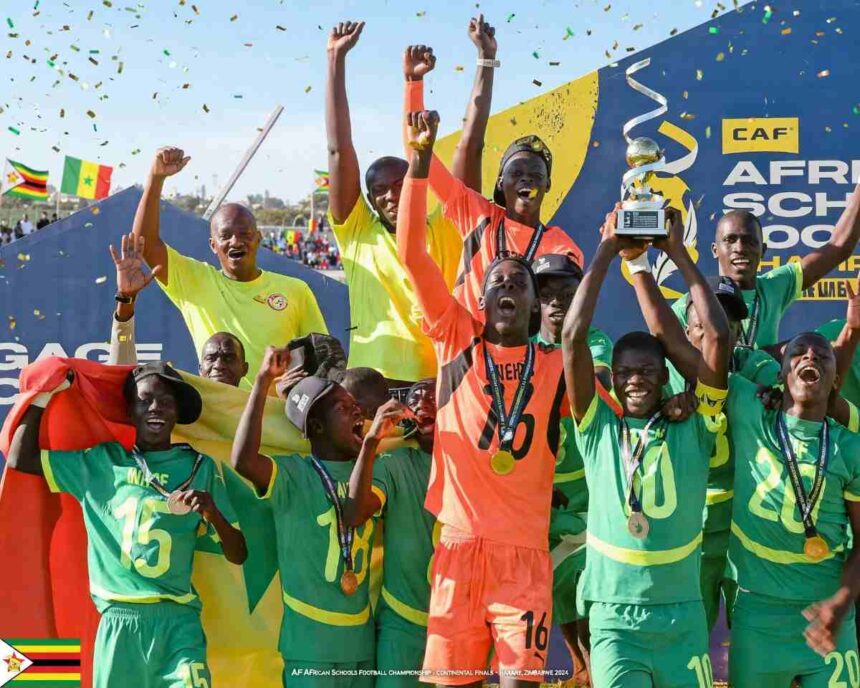
The race for places at the 2026/27 CAF African Schools Football Championship Continental Finals is under way, with qualifiers taking place across Africa’s six zonal unions.
Rwanda hosted the first qualifying tournament in the CECAFA Zone from 3 to 5 September. Tanzania won the girls’ competition, while Uganda claimed the boys’ title. Both teams have secured their places at next year’s Continental Finals.
Five more zonal tournaments will follow. WAFU A, WAFU B, COSAFA, UNIFFAC and UNAF will each stage a qualifier, with their winners joining Tanzania and Uganda at the continental showpiece.
The remaining fixtures will take place in Liberia, Togo, South Africa, Gabon and Algeria. The schedule runs from November to December, bringing together young teams from across the continent.
Five Zones Set to Complete Qualifying Campaign
Liberia will host the WAFU A qualifiers from 21 to 28 November. Togo will then stage the WAFU B competition from 29 November to 3 December.
South Africa will welcome COSAFA teams from 4 to 6 December. Next, Gabon will host the UNIFFAC qualifiers from 19 to 22 December. Algeria will bring the qualifying campaign to a close with the UNAF tournament from 20 to 25 December.
The competition has produced several winners since its launch. In the boys’ category, Guinea’s CS Ben Sekou Sylla won the first edition in 2022/23. Tanzania claimed the title in 2023/24 and 2024/25, before Senegal won in 2025/26.
The girls competition has also seen different countries enjoy success. Tanzania’s Fountain Gate School won in 2022/23, while South Africa took the title in 2023/24. Ghana then secured back to back victories in 2024/25 and 2025/26.

CAF launched the African Schools Football Championship in April 2022 in Maputo, Mozambique. CAF President Dr Patrice Motsepe introduced the competition to create more opportunities for young players and strengthen school football across the continent.
The programme aims to identify emerging talent while building stronger links between sport and education. It also promotes social development through football.
However, the initiative goes beyond the matches. CAF runs a capacity building programme alongside the tournament to help schools and host communities develop skills, knowledge and practical experience.
The 2026/27 campaign will mark the fourth edition of the programme. Since its launch, the competition has grown into what CAF describes as the world’s biggest schools football competition.
The Motsepe Foundation supports the championship through a USD 10 million investment. The funding covers prize money and wider development efforts across the programme.
Importantly, schools do not simply receive prize money for their teams’ performances. They must invest the funds in development projects that improve their educational and sporting facilities.
At zonal level, the boys’ and girls’ winners each receive USD 100,000. The runners up earn USD 75,000, while third placed teams receive USD 50,000.
The rewards increase at the Continental Finals. Each category’s winners will receive USD 300,000, with USD 200,000 going to the runners up and USD 150,000 to the third placed teams.
CAF will also run its African Schools Programme alongside the 2026/27 qualifiers. The initiative includes training and development opportunities for young people and football officials.
Its activities include the CAF Young Referees Programme, Young Reporters Programme and Young Medical Officers Programme. It also features the CAF D-License Coaching Course and safeguarding programmes.
Through these initiatives, CAF aims to develop skills in refereeing, coaching, sports journalism, medical services and football administration. The programmes also promote safeguarding and help create safer environments for young players.
With the first zonal champions already confirmed, attention now turns to the remaining five qualifiers. Their winners will complete the line-up for the 2026/27 CAF African Schools Football Championship Continental Finals.